
Struggling with cracked shells, hollow macarons, or feet that won’t form? You’re not alone. French macarons have a notorious reputation as one of the most temperamental desserts in baking—one tiny mistake and you’re left with expensive almond flour wasted and disappointment.
This vanilla macaron recipe delivers perfect, Instagram-worthy macarons with smooth tops, ruffled feet, and that signature chewy-crisp texture every single time. No more guesswork, no more failures, just reliable results using 3 proven techniques that professional pastry chefs swear by.
As a French pastry chef who’s been teaching macaron classes for over 10 years, I’ve helped thousands of home bakers master this “impossible” cookie. The secret isn’t magic—it’s understanding three critical mind hacks that change everything: the aging technique, the macaronage fold, and the resting method.
In this comprehensive guide, you’ll discover why this vanilla macaron recipe works flawlessly, how to choose the right ingredients, detailed step-by-step instructions with visual cues, the 3 viral mind hacks that guarantee success, pro tips for troubleshooting common problems, flavor variations, and answers to every macaron question you’ve ever had.
Table of Contents
Mastery begins the moment you stop fearing failure and start understanding the science behind it.
Recipe Overview
| Detail | Information |
|---|---|
| Prep Time | 30 minutes (plus 24-48 hours aging) |
| Cook Time | 12-15 minutes per batch |
| Total Time | 2 hours (active time) |
| Servings | 24-30 macaron shells (12-15 sandwiched macarons) |
| Course | Dessert/Confection |
| Cuisine | French |
| Oven Temperature | 300°F (150°C) |
| Calories per Macaron | 80-100 kcal (with filling) |
Why This Vanilla Macaron Recipe Works
This vanilla macaron recipe stands out for three compelling reasons: scientific precision, foolproof technique, and consistent results.
- Uses the Italian meringue method – More stable than French meringue, virtually crack-proof
- Aged egg whites create stability – 24-48 hours of aging develops the perfect protein structure
- Precise measurements in grams – Weight measurements eliminate variables that cause failure
- Controlled resting time – Forms the critical skin that prevents cracking
- Temperature-tested baking – 300°F sweet spot for perfect texture
- Versatile vanilla base – Adapts to any flavor or color you desire
- Professional results at home – No special equipment beyond a stand mixer needed
Choosing the Right Ingredients
Best Almond Flour for Macarons
The quality of almond flour directly determines macaron success. Blanched, superfine almond flour is non-negotiable. Bob’s Red Mill Super-Fine Almond Flour or Mandelin Blanched Almond Flour are gold standards. Never use almond meal (with skins) or regular ground almonds—they create grainy, uneven shells.
Sift almond flour twice – This single step eliminates 90% of texture problems. Discard any large pieces that won’t pass through the sifter.
Egg White Selection
Aged egg whites are the secret weapon. Separate eggs and leave whites uncovered in the refrigerator for 24-48 hours. This evaporates excess moisture and strengthens protein bonds, creating more stable meringue.
Fresh egg whites work but are less forgiving. If using fresh, add ⅛ teaspoon cream of tartar to stabilize.
Buying Tips
- Choose pure almond flour – Check ingredients; some brands add anti-caking agents that ruin texture
- Use room temperature egg whites – Take aged whites out 2 hours before baking
- Buy gel food coloring – Liquid colors add moisture and prevent proper drying
- Invest in quality vanilla – Pure vanilla extract or vanilla bean paste for best flavor
- Use superfine/caster sugar – Dissolves faster in meringue; pulse granulated sugar in food processor if needed
Substitutions
- Can’t age egg whites? Add ⅛ teaspoon cream of tartar per 3 egg whites
- No superfine sugar? Pulse granulated sugar in food processor for 30 seconds
- Almond-free needed? Use sunflower seed flour (shells will turn green when baked—this is normal)
- Flavor variations: Replace vanilla with almond extract, rose water, or citrus zest
Ingredients & Prep
For the Macaron Shells
| Ingredient | Quantity |
|---|---|
| Blanched almond flour | 110g (1 cup, sifted) |
| Powdered sugar | 200g (1¾ cups, sifted) |
| Egg whites (aged 24-48 hours), divided | 100g total (about 3 large eggs) |
| Granulated sugar | 50g (¼ cup) |
| Water | 40g (2½ tablespoons) |
| Fine sea salt | Pinch |
| Vanilla extract | 1 teaspoon |
| Gel food coloring (optional) | 2-3 drops |
For the Vanilla Buttercream Filling
| Ingredient | Quantity |
|---|---|
| Unsalted butter, softened | 115g (½ cup / 1 stick) |
| Powdered sugar, sifted | 150g (1¼ cups) |
| Heavy cream | 2 tablespoons |
| Vanilla extract | 1 teaspoon |
| Vanilla bean paste (optional) | ½ teaspoon |
| Fine sea salt | Pinch |
Prep Essentials
Age egg whites 24-48 hours ahead – This is Mind Hack #1. Separate eggs carefully (no yolk!), place whites in a clean bowl, cover loosely with plastic wrap, and refrigerate.
Sift dry ingredients twice – Combine almond flour and powdered sugar, then sift twice through a fine-mesh sieve. This removes lumps and aerates for smooth shells.
Prepare piping equipment – Fit a large piping bag with a ½-inch round tip. Print or draw 1.5-inch circles on parchment as a template (place template under parchment).
Bring egg whites to room temperature – Take aged whites out 2 hours before starting. Room temp whites whip to greater volume.
Set up baking sheets properly – Line with parchment paper or silicone mats. Have templates ready underneath.
Step-by-Step Baking Instructions
Mind Hack #1: The Aging & Temperature Technique
| Step | Time/Temp | Key Point |
|---|---|---|
| Age egg whites | 24-48 hours | Refrigerate uncovered, strengthens proteins |
| Room temperature | 2 hours | Whites must be 65-70°F for proper volume |
| Preheat oven | 300°F | Lower temp prevents hollow shells |
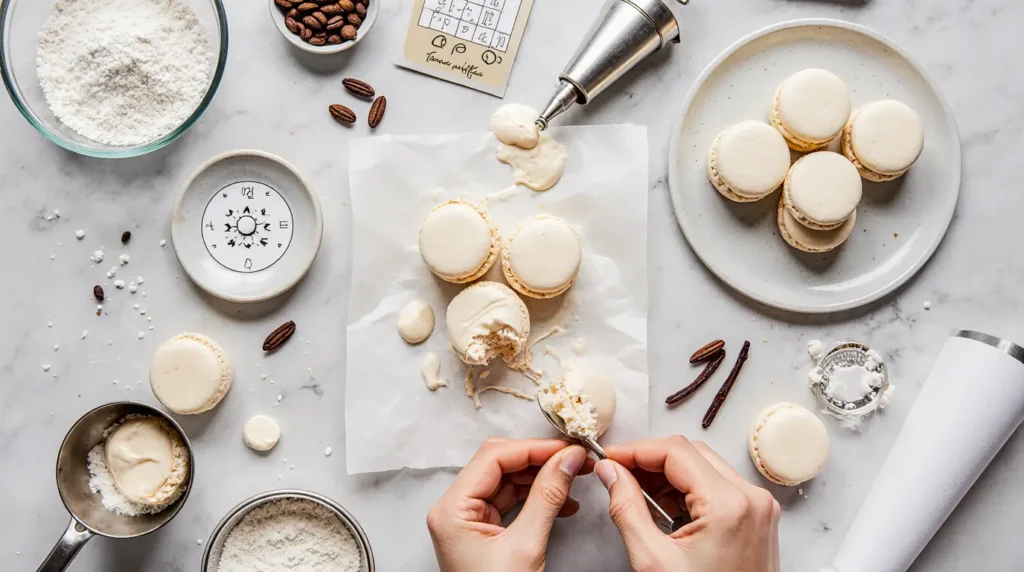
Why this works: Aged egg whites have reduced moisture content (about 10% less), which creates more concentrated proteins. These proteins bond more tightly during whipping, forming a stronger meringue structure that holds up during macaronage and baking. Room temperature whites also whip faster and achieve greater volume because warm proteins unfold more easily.
Mind Hack #2: The Italian Meringue Method
Step 1: Make Italian Meringue
- Combine 50g granulated sugar and 40g water in a small saucepan. Heat over medium heat without stirring.
- When syrup reaches 230°F (110°C), start whipping 50g egg whites (half your total) with a pinch of salt in a stand mixer on medium speed.
- When syrup reaches 245°F (118°C), remove from heat immediately.
- With mixer running on medium speed, slowly pour hot syrup down the side of the bowl into whipping egg whites (avoid hitting the whisk).
- Increase speed to high and whip for 8-10 minutes until meringue is thick, glossy, and cooled to room temperature. The bowl should feel barely warm.
- Add vanilla extract and gel food coloring (if using) in the last 30 seconds of mixing.
Why this works: Italian meringue is far more stable than French meringue (just whipped egg whites and sugar). The hot sugar syrup cooks the egg whites, creating a marshmallow-like structure that’s nearly impossible to overmix or deflate. This is why Italian method macarons have fewer cracks and more consistent results.
Mind Hack #3: The Macaronage Technique
Step 2: Master the Macaronage
- Add remaining 50g egg whites to the sifted almond flour and powdered sugar mixture. Mix briefly to form a thick paste.
- Add ⅓ of the Italian meringue to the almond paste. Fold vigorously with a spatula to lighten the mixture—don’t worry about deflating at this stage.
- Add remaining meringue in two additions, folding gently but deliberately. Use a “J” motion: scrape down the side, cut through the center, fold over.
- The test: Lift the spatula and let batter ribbon down. It should flow like lava, forming a ribbon that disappears back into the batter within 10-15 seconds. If it holds its shape longer, fold 2-3 more times.
- Visual cue: When you lift and drop batter, it should flow off the spatula in one continuous stream, not in globs or chunks.
Why this works: Macaronage is the most critical step. Under-mixed batter creates thick, lumpy shells without feet. Over-mixed batter spreads too much and creates flat, cracked shells. The “lava flow” test (10-15 second ribbon) is the foolproof indicator of perfect consistency.
Step 3: Pipe the Shells
- Transfer batter to prepared piping bag with ½-inch round tip.
- Hold bag vertically, ½ inch above parchment. Pipe in steady circles to fill template guides (1.5 inches).
- Stop piping, then quickly lift straight up with a small twist to avoid peaks.
- Lift tray 2 inches and drop firmly on counter 5-6 times. Rotate and repeat. This releases air bubbles.
- Use a toothpick to pop any visible air bubbles on the surface.
Step 4: The Critical Rest (Mind Hack Integration)
- Let piped shells rest at room temperature for 30-60 minutes until a skin forms.
- The touch test: Gently touch a shell. Your finger should come away clean without any batter sticking.
- This skin formation is critical—it prevents cracking and helps feet form during baking.
Why this works: The resting period allows moisture to evaporate from the surface, creating a protective shell. When heat hits this dried skin in the oven, it can’t expand upward (which causes cracks). Instead, pressure escapes from the bottom, pushing up to form the signature ruffled feet.
Step 5: Baking
- Preheat oven to 300°F (150°C) with rack in the center position.
- Bake one tray at a time for 12-15 minutes. Shells should not brown.
- Doneness test: Gently touch the top of a shell. It should not wobble or slide on its base.
- If shells wobble, bake 1-2 minutes longer.
- Let cool completely on the baking sheet (10 minutes), then peel off parchment gently.
Step 6: Make Vanilla Buttercream
- Beat softened butter on medium-high speed for 3 minutes until fluffy and pale.
- Add sifted powdered sugar ½ cup at a time, beating after each addition.
- Add heavy cream, vanilla extract, vanilla bean paste, and salt. Beat for 2-3 minutes until light and smooth.
- Transfer to piping bag fitted with small round or star tip.
Step 7: Assembly
- Match shells by size, flipping half upside-down.
- Pipe a small mound of buttercream (about 1 teaspoon) on the flat side of upside-down shells.
- Sandwich with a matching top shell, pressing gently to spread filling to edges.
- Refrigerate assembled macarons in airtight container for 24 hours before serving—this is called “maturation.”
Patience transforms good technique into extraordinary results that speak for themselves.
Pro Tips for Perfect Macarons
Avoiding Common Failures
- Cracked shells: Caused by under-resting (no skin formed) or oven temperature too high
- No feet: Macaronage was under-mixed, batter too thick, or oven temperature too low
- Hollow shells: Oven too hot causing rapid expansion, or meringue over-whipped
- Lopsided feet: Oven has hot spots; rotate tray halfway through baking
- Shells stick to parchment: Under-baked; bake 1-2 minutes longer or cool completely before removing
Environmental Factors
Humidity is macaron’s enemy. If humidity is above 65%, macarons may not form proper skin during resting. Solutions:
- Use a dehumidifier in your kitchen
- Point a fan at the trays during resting
- Extend resting time to 60-90 minutes
- Add 5g (1 teaspoon) more powdered sugar to batter
Rainy days: Seriously consider postponing macaron-making. High humidity makes success significantly harder.
Tool Recommendations
A kitchen scale that measures in grams is absolutely essential. Volume measurements are too imprecise for macarons.
A candy/digital thermometer ensures perfect Italian meringue temperature—245°F is the magic number.
Silicone baking mats provide more consistent results than parchment paper and prevent sticking.
A stand mixer is highly recommended. Hand mixers work but make Italian meringue more challenging.
Storage Guide
| Storage Method | Duration | Instructions |
|---|---|---|
| Room temperature (unfilled shells) | 1 week | Store in airtight container with silica packets |
| Refrigerated (filled) | 5-7 days | Store in airtight container; bring to room temp 30 min before serving |
| Frozen (unfilled shells) | 3 months | Layer with parchment in airtight container; thaw at room temp |
| Frozen (filled) | 2 months | Individual wrap or layer with parchment; thaw in fridge overnight |
Maturation is key: Filled macarons taste better after 24-48 hours in the fridge. The filling hydrates the shells, creating the perfect chewy texture.
Flavor Variations
Chocolate Macarons
Replace 10g almond flour with 10g cocoa powder. Add chocolate ganache filling: heat 100ml heavy cream, pour over 100g chopped dark chocolate, stir until smooth, cool until spreadable.
Lemon Macarons
Add 1 teaspoon lemon zest to meringue. Fill with lemon curd or lemon buttercream (add 2 tablespoons lemon juice and 1 tablespoon lemon zest to buttercream recipe).
Raspberry Macarons
Add 2-3 drops pink gel coloring and ½ teaspoon raspberry extract to meringue. Fill with raspberry jam and vanilla buttercream layered together.
Pistachio Macarons
Replace 20g almond flour with finely ground pistachios. Add 2-3 drops green gel coloring. Fill with pistachio buttercream (add 3 tablespoons pistachio paste to buttercream recipe).
Salted Caramel Macarons
Fill with salted caramel buttercream: add 3 tablespoons caramel sauce and ½ teaspoon flaky sea salt to buttercream recipe.
Coffee Macarons
Add 2 teaspoons instant espresso powder to dry ingredients. Fill with coffee buttercream (dissolve 1 tablespoon instant espresso in 1 teaspoon hot water, add to buttercream).
Serving Suggestions
French macarons are elegant desserts perfect for special occasions:
Perfect For
- Elegant tea parties – Classic French pastry for afternoon tea
- Wedding favors – Beautiful and customizable for any color scheme
- Gift boxes – Package in clear boxes with ribbon for impressive gifts
- Dessert platters – Arrange with fresh berries and chocolate
- Special celebrations – Birthday parties, anniversaries, baby showers
Pairing Suggestions
With beverages: Champagne, espresso, Earl Grey tea, or dessert wine like Sauternes
As part of dessert spread: Pair with fresh fruit, chocolate truffles, and petit fours
Seasonal presentations: Match colors and flavors to holidays (pink for Valentine’s, pastels for Easter, red/green for Christmas)
FAQs
Can I make macarons without aging egg whites? Yes, but add ⅛ teaspoon cream of tartar per 3 egg whites to stabilize fresh whites. Results will be less consistent but still good.
Why did my macarons crack? Most common causes: didn’t rest long enough (no skin formed), oven temperature too high, or oven door opened during baking. Always do the touch test before baking.
My macarons have no feet. What went wrong? Either the batter was under-mixed (too thick) or oven temperature was too low. The batter should flow like lava, and oven must be precisely 300°F.
Can I use a hand mixer instead of stand mixer? Yes, but Italian meringue is more difficult. Hold the bowl steady while slowly pouring hot syrup—have someone help or use a damp towel under the bowl to stabilize it.
How do I fix hollow macarons? Hollow shells are caused by oven temperature too high or meringue over-whipped. Reduce oven to 290°F and whip meringue just until stiff peaks form, not beyond.
Can I make macarons on a humid day? It’s challenging but possible. Use a fan pointed at trays during resting, extend rest time to 60-90 minutes, and consider adding 5g more powdered sugar to batter.
Do I really need to weigh ingredients? Yes. Macarons are chemistry, and precise ratios are critical. Volume measurements (cups) vary too much and lead to inconsistent results.
Why do my shells stick to parchment? They’re under-baked. Bake 1-2 minutes longer, or let them cool completely on the tray before removing. Silicone mats prevent sticking better than parchment.
Can I color macarons with natural food coloring? Natural powdered colors work better than natural liquids (which add moisture). Use freeze-dried fruit powder for beautiful natural color and flavor.
Is this recipe safe during pregnancy? The Italian meringue method heats egg whites to 245°F, which pasteurizes them and makes them safe. This is one reason Italian method is preferred over French method.
True excellence in baking comes from understanding that every failure teaches the lesson that leads to mastery.
Conclusion
This vanilla macaron recipe transforms one of baking’s most intimidating challenges into an achievable triumph. The 3 proven mind hacks—aging egg whites, Italian meringue method, and proper macaronage—eliminate guesswork and deliver consistent, professional results every time.
Master these techniques and create your first perfect batch today! Once you understand the science behind each step, macarons become not just possible, but reliably beautiful.
Join thousands of home bakers who’ve conquered the macaron challenge using these exact techniques. After you’ve perfected vanilla macarons, explore our [French Pastry Guide] or [Advanced Macaron Flavors Collection] to expand your repertoire.
Now grab your aged egg whites and your kitchen scale—it’s time to create magic! 🇫🇷✨
Vanilla macaron recipe
Ingredients
- For the Macaron Shells
- 110 g blanched almond flour (1 cup, sifted)
- 200 g powdered sugar (1¾ cups, sifted)
- 100 g egg whites total (about 3 large eggs, divided into 50g portions)
- 50 g granulated sugar (¼ cup)
- 40 g water (2½ tablespoons)
- Pinch of fine sea salt
- 1 teaspoon vanilla extract
- 2-3 drops gel food coloring (optional)
- For the Vanilla Buttercream Filling
- 115 g unsalted butter (softened (½ cup / 1 stick))
- 150 g powdered sugar (sifted (1¼ cups))
- 2 tablespoons heavy cream
- 1 teaspoon vanilla extract
- ½ teaspoon vanilla bean paste (optional)
- Pinch of fine sea salt
Instructions
- Preparation (24-48 Hours Before)
- Separate eggs carefully (no yolk). Place 100g egg whites in a clean bowl, cover loosely with plastic wrap, and refrigerate uncovered for 24-48 hours.
- Day of Baking
- Take aged egg whites out of refrigerator 2 hours before starting to bring to room temperature (65-70°F).
- Combine almond flour and powdered sugar. Sift twice through fine-mesh sieve, discarding any large pieces.
- Preheat oven to 300°F (150°C) with rack in center position.
- Line baking sheets with parchment paper or silicone mats. Place circle templates (1.5 inches) underneath parchment.
- Prepare piping bag with ½-inch round tip.
- Make Italian Meringue
- Combine 50g granulated sugar and 40g water in small saucepan. Heat over medium heat without stirring.
- When syrup reaches 230°F (110°C), start whipping 50g egg whites with pinch of salt in stand mixer on medium speed.
- When syrup reaches 245°F (118°C), remove from heat immediately.
- With mixer on medium speed, slowly pour hot syrup down side of bowl into whipping egg whites, avoiding the whisk.
- Increase speed to high and whip for 8-10 minutes until meringue is thick, glossy, and cooled to room temperature (bowl feels barely warm).
- Add vanilla extract and gel food coloring in last 30 seconds of mixing.
- Make Macaron Batter (Macaronage)
- Add remaining 50g egg whites to sifted almond flour and powdered sugar mixture. Mix briefly to form thick paste.
- Add ⅓ of Italian meringue to almond paste. Fold vigorously with spatula to lighten mixture.
- Add remaining meringue in two additions, folding gently using “J” motion: scrape down side, cut through center, fold over.
- Test consistency: Lift spatula and let batter ribbon down. It should flow like lava, forming ribbon that disappears back into batter within 10-15 seconds. If it holds shape longer, fold 2-3 more times.
- Pipe and Rest
- Transfer batter to prepared piping bag.
- Hold bag vertically ½ inch above parchment. Pipe in steady circles to fill 1.5-inch template guides.
- Stop piping, then quickly lift straight up with small twist to avoid peaks.
- Lift tray 2 inches and drop firmly on counter 5-6 times. Rotate and repeat to release air bubbles.
- Use toothpick to pop any visible surface air bubbles.
- Let piped shells rest at room temperature for 30-60 minutes until skin forms. Touch test: finger should come away clean without batter sticking.
- Bake
- Bake one tray at a time for 12-15 minutes. Shells should not brown.
- Doneness test: Gently touch top of shell—it should not wobble or slide on base. If it wobbles, bake 1-2 minutes longer.
- Let cool completely on baking sheet (10 minutes), then peel off parchment gently.
- Make Vanilla Buttercream
- Beat softened butter on medium-high speed for 3 minutes until fluffy and pale.
- Add sifted powdered sugar ½ cup at a time, beating after each addition.
- Add heavy cream, vanilla extract, vanilla bean paste, and salt. Beat 2-3 minutes until light and smooth.
- Transfer to piping bag fitted with small round or star tip.
- Assemble
- Match shells by size, flipping half upside-down.
- Pipe small mound of buttercream (about 1 teaspoon) on flat side of upside-down shells.
- Sandwich with matching top shell, pressing gently to spread filling to edges.
- Refrigerate assembled macarons in airtight container for 24 hours before serving (maturation period).
Notes
Mind Hack #1: Aging Egg Whites (24-48 Hours) Aged egg whites have 10% less moisture, creating more concentrated proteins
Stronger protein bonds form more stable meringue that resists deflating
Room temperature aged whites (65-70°F) whip faster and achieve greater volume
If using fresh whites, add ⅛ teaspoon cream of tartar per 3 egg whites Mind Hack #2: Italian Meringue Method Hot sugar syrup (245°F) cooks egg whites, creating marshmallow-like structure
Far more stable than French meringue (just whipped whites and sugar)
Nearly impossible to overmix or deflate
Results in fewer cracks and more consistent texture Mind Hack #3: Macaronage Technique & Lava Flow Test Perfect consistency = batter flows like lava, ribbon disappears in 10-15 seconds
Under-mixed: Creates thick, lumpy shells without feet
Over-mixed: Spreads too much, creates flat cracked shells
The “lava flow” test is the foolproof indicator of success Critical Success Factors Use a kitchen scale – Weight measurements in grams are essential; volume measurements are too imprecise
Sift dry ingredients twice – Eliminates lumps and aerates for smooth shells
Rest until skin forms – Touch test must pass; prevents cracking and helps feet form
Precise oven temperature – 300°F is the sweet spot; use oven thermometer
One tray at a time – Ensures even baking and proper heat distribution
Maturation is key – 24-48 hours in fridge after filling creates perfect chewy texture Troubleshooting Common Problems Cracked shells: Under-rested (no skin), oven too hot, or door opened during baking
No feet: Batter under-mixed (too thick) or oven temperature too low
Hollow shells: Oven too hot causing rapid expansion, or meringue over-whipped
Lopsided feet: Oven hot spots; rotate tray halfway through baking
Shells stick: Under-baked; bake 1-2 minutes longer or cool completely before removing
Flat spreading shells: Batter over-mixed or resting time insufficient Environmental Considerations Humidity above 65%: Use dehumidifier, point fan at trays, extend rest time to 60-90 minutes, or add 5g more powdered sugar
Rainy days: Consider postponing—high humidity makes success significantly harder
Temperature: Ideal kitchen temperature is 68-72°F Storage Instructions Room temperature (unfilled): 1 week in airtight container with silica packets
Refrigerated (filled): 5-7 days in airtight container; bring to room temp 30 min before serving
Frozen (unfilled): 3 months layered with parchment in airtight container; thaw at room temp
Frozen (filled): 2 months individually wrapped; thaw in fridge overnight Flavor Variations Chocolate: Replace 10g almond flour with cocoa powder; fill with chocolate ganache
Lemon: Add 1 tsp lemon zest to meringue; fill with lemon curd
Raspberry: Add ½ tsp raspberry extract and pink coloring; fill with raspberry jam
Pistachio: Replace 20g almond flour with ground pistachios; add green coloring
Coffee: Add 2 tsp instant espresso to dry ingredients; fill with coffee buttercream
Salted Caramel: Fill with salted caramel buttercream Equipment Recommendations Kitchen scale measuring in grams (essential)
Candy/digital thermometer for Italian meringue
Stand mixer (highly recommended over hand mixer)
Silicone baking mats (more consistent than parchment)
Large piping bag with ½-inch round tip
Fine-mesh sieve for sifting Special Notes Italian meringue method heats egg whites to 245°F, pasteurizing them (safe during pregnancy)
Almond-free option: Use sunflower seed flour (shells will turn green when baked—this is normal)
Use gel food coloring only—liquid adds moisture and prevents proper drying
Natural coloring: Freeze-dried fruit powder works better than natural liquid colors